
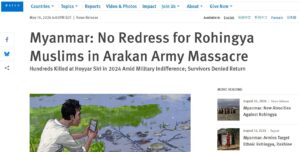
The May 18, 2026 Human Rights Watch (HRW) report “‘Skeletons and Skulls Scattered Everywhere’: Arakan Army Massacre of Rohingya Muslims in Hoyyar Siri, Myanmar” presented detailed evidence, drawn from 41 witness interviews (mostly Rohingya survivors who later reached Bangladesh or Malaysia), geolocated photographs and videos of human remains, satellite imagery analysis, and forensic review of images showing piles of skeletons and skulls, that Arakan Army (AA) fighters deliberately killed at least 170 Rohingya civilians (including ~90 children) and likely hundreds more on May 2, 2024, in Hoyyar Siri village (known locally in Burmese as Htan Shauk Khan) in Buthidaung Township, northern Rakhine State.
The United League of Arakan (ULA), the AA’s political wing responded through its Humanitarian and Development Coordination Office (HDCO) with a lengthy June 16, 2026 document titled “A Factual and Evidentiary Assessment of the Htan Shauk Khan Battle.” This 57-page report, framed as an independent humanitarian review, systematically denies that the AA massacred civilians. It recasts the events as chaotic multi-actor battlefield fighting involving retreating Myanmar military forces, locally recruited Muslim combatants, artillery, and aerial attacks.
It claims successful ULA/AA-organized evacuations, near-complete population accounting that “challenges” the death toll, 930 surrenders explaining many remains, and generous post-battle humanitarian assistance including a new “New Htan Shauk Khan” village.
This HDCO document is not a credible independent assessment. It is a partisan propaganda exercise produced by an office directly tied to the accused party. It selectively uses data, misrepresents geography and timelines, manipulates population and surrender statistics, applies double standards to witness testimony, and omits or distorts contradictory evidence.
Multiple independent sources including Fortify Rights, references in UN OHCHR documentation, satellite analysis by groups like Bellingcat and others, Rohingya activist tracking, and consistent survivor accounts, corroborate the core of the HRW findings: deliberate AA targeting of fleeing unarmed civilians.
Below is a point-by-point rebuttal of the HDCO report’s central claims, exposing its key lies, omissions, and distortions.
The Fabricated Evacuation Narrative and Reversal of Flight Direction (Core Lie on Events of May 2)
HDCO claim :
Beginning mid-April, ULA authorities and Muslim community leaders discussed evacuations. On May 2 at ~6 a.m., loudspeaker warnings were issued; by ~8 a.m. large numbers moved westward toward U Hla Hpay madrasa and host villages. This was an organized, successful civilian protection measure.
Evidence-based rebuttal :
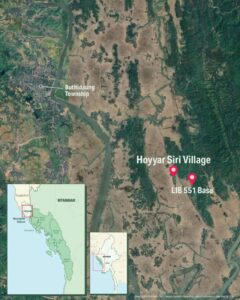
This is directly contradicted by the geography, multiple independent witness accounts, and corroborating investigations. Hoyyar Siri/Htan Shauk Khan lies along the Buthidaung–Rathedaung road, with MOC-15 to the north and LIB-551 to the southeast. After MOC-15 fell on May 2, many residents (including hosted displaced families) attempted to flee north toward Buthidaung town around 7 a.m., in large groups, many carrying white flags.
Fortify Rights documented that AA forces stopped the first group beside the main road heading toward downtown Buthidaung and opened fire, killing scores.
HRW witnesses describe the column halting at a hill/area known as Toinna Mura; AA fighters appeared from multiple directions and opened fire without warning or announcement to halt/turn back. Survivors describe chaos, close-range shootings (5 feet / 1.5 m in one account), families killed together, bodies in fields and on the road, and some gathered near a mosque/paddy field and shot (“no one was spared”).
U Hla Hpay is a real nearby village (mentioned in other conflict contexts), but there is no credible independent corroboration of a successful organized westward evacuation on May 2 that prevented mass killing. Instead, survivors were scattered; many who reached areas like U Hla Hpay were intercepted by AA.
The HDCO’s timeline and direction appear invented or heavily sanitized to portray the AA as protective rather than the force that halted and fired on the fleeing column.
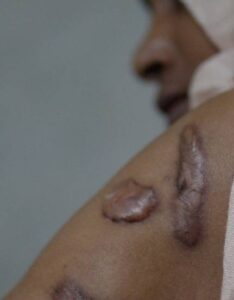
Survivor documenting remains in a paddy field/water body months later, consistent with described execution sites.
Misleading Population “Reconciliation” to Downplay the Death Toll
HDCO claim :
A 2023 registration recorded 933 permanent residents. Post-battle, >910 were registered across host villages within days; a later signed reconciliation accounted for 928 living in Buthidaung Township or abroad. This “close correspondence” (differing by only five) “materially challenges” HRW’s figure of >170 killed or missing as permanent residents. HRW allegedly fails to distinguish permanent residents from temporary displaced persons.
Rebuttal :
This is statistical sleight-of-hand that ignores context and specific evidence. Hoyyar Siri had become a gathering point for Rohingya fleeing earlier AA advances in surrounding areas; many households hosted two or three displaced families. The 170+ named by HRW (and higher estimates from Rohingya trackers up to 500–600) included these hosted/temporary arrivals, not solely “permanent” 2023 residents.
Aggregate headcounts do not disprove named individual deaths. The “reconciled” 928 figure excludes the dead and missing; some survivors only reached Bangladesh in 2025 and spoke later. HDCO provides no transparent, public, name-by-name comparison against HRW’s victim list (which HRW compiled from direct testimony). Their own access to full underlying data is unclear, and they admit limitations in forensics. This section functions as rhetorical deflection rather than evidence-based rebuttal.
Self-Serving “Surrender” Figures Used to Explain Human Remains
HDCO claim :
ULA/AA records show 930 persons surrendered in the final phase around Htan Shauk Khan: 406 Myanmar military personnel, 11 members of aligned armed groups, and 513 military family members/dependants. This demonstrates substantial military-associated presence; without forensics, remains cannot be attributed solely to civilians or to the AA.
Rebuttal :
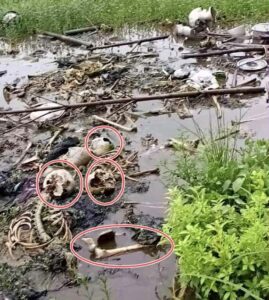
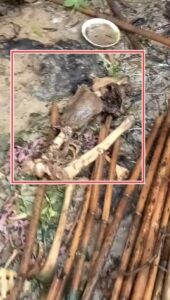
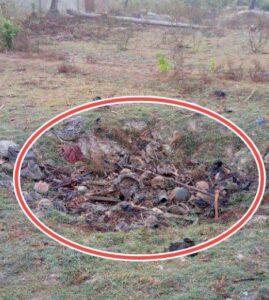
Surrenders occurred after the main reported killings of fleeing civilians on May 2. The 513 “family/dependants” category includes non-combatants, but does not explain the specific pattern of remains: scattered in paddy fields, roads, and alleged execution sites (e.g., near Toinna Mura or a mosque/paddy area), with clothes intact and advanced decomposition noted months later. Forensic review of photos/videos by the Independent Forensic Expert Group (for HRW) assessed piles of human remains consistent with mass death of civilians.
While Myanmar military forced recruitment of Rohingya (including boys) and cooperation with ARSA/RSO elements is documented and contributed to a militarized environment (acknowledged even in HRW reporting), this does not justify or explain the deliberate targeting of a large column of fleeing unarmed civilians (women, children, families) waving white flags. The HDCO uses the presence of some armed actors to blur all deaths into “battlefield” casualties.
Denial of Deliberate Targeting and Over-Reliance on “Battlefield Chaos” Framing
HDCO claim :
The village became part of an intense multi-actor military confrontation after retreating Myanmar forces and allies moved in. It was not a one-sided assault on an isolated civilian settlement. AA followed early warning, proportionality, and distinction per IHL.
Rebuttal :
The broader context of fighting, junta abuses, and presence of various armed actors is real and relevant. However, the consistent, corroborated witness testimony across HRW and Fortify Rights describes targeted attacks on the halted civilian procession after it had left the village and was seeking safety—not incidental crossfire or pursuit of armed fighters. AA fighters allegedly appeared from several directions, fired without warning, and in some accounts gathered and shot groups. Satellite imagery analyzed by HRW and others shows the village was burned and destroyed after AA gained control—consistent with post-massacre looting and arson, not solely pre-existing battle damage.
The HDCO’s IHL compliance claims are self-asserted and contradicted by the pattern of evidence. No independent verification of “early warning” effectiveness exists; instead, earlier military orders reportedly prevented flight (“If you die, we die”).
Hypocritical Double Standards on Witnesses and Methodology
HDCO claim :
HRW relied heavily on pseudonymous testimony from Bangladesh camps (where armed groups and criminal networks operate, creating risks of influence). Accounts from ULA/AA areas are unfairly presumed coerced. Unequal evidentiary standards distort the record.
Rebuttal :
Witness risks exist on both sides—valid point. However, the HDCO applies it selectively while ignoring AA coercion: survivors still in Myanmar were reportedly forced to produce false exculpatory videos exonerating the AA. Many witnesses only felt safe speaking after fleeing AA-controlled territory in 2025. HRW’s methodology included private interviews, multiple corroborations per account, cross-checking with satellite/geolocated photos/videos, and forensic review. HDCO’s own sources (“ULA/AA operational information,” “local sources,” village committee registrations) are inherently self-interested and lack equivalent independent scrutiny or transparency. The report criticizes lack of DNA/autopsies/ballistics (a genuine limitation for both sides in a conflict zone) but offers no superior alternative forensics.
Whitewashing Post-Battle Abuses: “Humanitarian Assistance” vs. Forced Relocation and Denial of Return
HDCO claim :
Displaced residents received food, shelter materials, cash, healthcare, education, and livelihood support. By May 2026 ~700 were in “New Htan Shauk Khan”; humanitarian agencies (including international) continued assistance. Records inconsistent with claims of abandonment.
Rebuttal :
Independent accounts describe forced relocation of survivors to a makeshift camp at Nassawr Para (Hnget Thay / Ah Twin Hnget Thay area, ~3 km south), with inadequate food/medical care, denied freedom of movement, and forced labor. The original village was burned and rendered uninhabitable (satellite confirmed); residents have been prevented from returning, with AA citing landmines/unexploded ordnance (while reportedly building some structures like possible checkpoints or cattle sheds there).
The “New Htan Shauk Khan” appears to be a rebranded or relocated camp under AA control, presented with a humanitarian gloss. Survivors in AA areas remain effectively detained; those who escaped to Bangladesh seek justice but face return pressures. This contradicts the HDCO’s portrayal of voluntary, well-supported relocation and ongoing access.
Hoyyar Siri Is Not An Isolated Case
Set the HDCO document aside completely, and the allegations against the Arakan Army still don’t stand alone. They sit inside a documented pattern recorded independently by several organisations over more than two years.
When Arakan Army forces captured Buthidaung town in May 2024, they shelled, looted, and burned Rohingya neighbourhoods. A joint statement by Rohingya rights organisations said the offensive left more than two thousand Rohingya dead. Three months later, at least 200 Rohingya civilians were killed in strikes as they gathered at the Naf River trying to cross into Bangladesh.
Human Rights Watch, Fortify Rights, and Amnesty International investigated independently and reached the same conclusion: the strikes came from Arakan Army–held territory. One Amnesty witness described Arakan Army fighters moving Hindu and Buddhist families to safety while leaving Rohingya families where they were, and said he later watched fighters shoot a woman dead at a pond.
In July 2025, Fortify Rights asked the International Criminal Court to investigate the Arakan Army more broadly, pointing to detention sites where survivors said men had been restrained, beaten, and in some instances found beheaded. The UN’s Independent Investigative Mechanism for Myanmar reports credible evidence that armed groups fighting the military have carried out killings without trial of people suspected of being informers.
None of this erases the Myanmar military’s own record of mass killing and genocidal acts against the Rohingya. But neither fact is a defense for Hoyyar Siri, and neither is really what HDCO’s document is about. It spends far more pages casting doubt on the people making accusations than answering the specific, forensically documented evidence against its own fighters.
What Real Accountability Would Look Like
The Arakan Army said it would allow investigations by international human rights groups it considers credible and independent. That is the right principle. It now has to mean something.
A credible inquiry is not the Arakan Army’s own civil affairs office producing a rebuttal against itself. It looks like full access without Arakan Army escorts for the UN’s Independent Investigative Mechanism, the UN Special Rapporteur, and independent forensic teams to the Hoyyar Siri site itself, and to survivors still living under restriction. It looks like releasing the full list of names the Arakan Army says it already has so that families and neutral investigators can check it against the dead, the missing, and the living. And it means no more managed “media visits” producing testimony survivors say was given under pressure.
Two years after Hoyyar Siri burned, the people who survived it are still waiting for someone other than the Arakan Army to tell them what happened to their families. A document written by the accused, about the accused, for the accused, is not that answer.